
Video Feedback: Transforming Communication and Collaboration
Video feedback enables asynchronous communication, boosts clarity and learning, and streamlines collaboration. Learn types, benefits, risks, and best practices.
Devdeep
Author
Video Feedback: Transforming Communication and Collaboration

Most American professionals still rely on written messages, even though video feedback can increase understanding by up to 40 percent compared to text alone. As teams grow more distributed and collaboration shifts online, the need for clear and engaging communication becomes urgent. Exploring the world of video feedback dissolves common myths and uncovers practical ways to connect, clarify, and make every exchange more meaningful in any professional American setting.
Table of Contents
Key Takeaways
| Point | Details |
|---|---|
| Video Feedback Enhances Communication | Video feedback combines visual and verbal elements to provide deeper understanding and engagement compared to traditional text-based methods. |
| Async Video Feedback Offers Flexibility | Asynchronous video feedback allows participants to review and respond at their convenience, breaking down time constraints in communication. |
| Diverse Video Feedback Types for Specific Needs | Different approaches, such as webcam and screen recording feedback, cater to various communication goals and enhance collaboration. |
| Privacy and Security Must Be Prioritized | Organizations need to implement robust security measures to protect sensitive information shared through video feedback channels. |
Defining Video Feedback and Common Misconceptions
- Defining Video Feedback And Common Misconceptions
- Types Of Video Feedback And Key Differences
- How Async Video Feedback Works In Practice
- Benefits For Teams, Creators, And Learning
- Risks, Privacy Concerns, And Mitigation Strategies
Video feedback represents a dynamic communication method that goes far beyond traditional text-based interactions. At its core, video feedback is a real-time or asynchronous process of providing visual and verbal commentary on work, performance, or content through recorded video messages. Unlike static written notes, video communication methods allow for nuanced expression, tone interpretation, and deeper contextual understanding.
Historically, video feedback emerged from technical contexts where camera systems could create recursive visual loops. Artistic and scientific applications initially explored these visual phenomena, but modern professionals have transformed the concept into a powerful collaborative tool. The technology enables individuals to record, share, and annotate visual content with unprecedented clarity and personal connection.
Common misconceptions about video feedback often stem from unfamiliarity with its capabilities. Many professionals mistakenly believe video feedback is time-consuming, complicated, or exclusively suited for specific industries. In reality, async video communication offers remarkable flexibility across multiple sectors. Academic researchers have demonstrated that video feedback can significantly enhance understanding, providing a more engaging alternative to traditional written commentary.
The most effective video feedback strategies prioritize clarity, brevity, and actionable insights. Successful communicators understand that the medium allows for rich, nuanced explanations that text simply cannot capture. By leveraging visual and verbal cues, video feedback transforms how teams collaborate, learn, and grow across diverse professional landscapes.
Types of Video Feedback and Key Differences
Video feedback encompasses several nuanced approaches that transform how professionals communicate and collaborate. Types of video content reveal a rich landscape of communication strategies, each with unique strengths and applications. Webcam video feedback, for instance, allows direct personal interaction, enabling presenters to convey emotional context and non-verbal cues that text-based communication cannot capture.

Screen recording feedback offers a different dimension of communication, particularly valuable in technical and educational settings. Effective video presentation formats demonstrate how professionals can provide detailed, step-by-step visual guidance. According to research, these approaches can be categorized into distinct types: webcam videos, screen recordings, and hybrid methods that combine visual elements to create comprehensive communication experiences.
The key differences between video feedback types emerge from their specific use cases and technical requirements. Synchronous video feedback happens in real-time, allowing immediate interaction and quick clarifications. Asynchronous video feedback provides flexibility, enabling participants to review and respond at their convenience. Educational researchers have highlighted that these approaches significantly enhance understanding by offering more engaging and personalized communication channels.
Professionals across industries can strategically select video feedback methods based on their specific communication goals. Modern video tool features now support seamless transitions between different feedback styles, empowering teams to choose the most effective approach for each unique scenario. The ultimate objective remains consistent: creating clear, meaningful, and impactful communication that transcends traditional textual limitations.
How Async Video Feedback Works in Practice
Async video feedback transforms traditional communication by enabling professionals to record, share, and review detailed visual commentary without real-time constraints. Complete async video communication strategies demonstrate how individuals can create meaningful interactions that transcend time and location limitations. The process typically begins with recording a comprehensive video message that captures nuanced explanations, visual demonstrations, and personal insights.
In educational and professional settings, async video feedback provides unprecedented flexibility and depth. Researchers have confirmed that video feedback for product teams allows for more precise, contextualized communication. The workflow involves creating a screen recording or webcam video that breaks down complex topics, annotates specific elements, and provides step-by-step guidance that written communication cannot easily replicate.
Practical implementation of async video feedback requires careful consideration of technical and communication elements. Key components include high-quality audio, clear visual demonstrations, and concise messaging. Async video features for freelancers highlight the importance of selecting appropriate recording tools, managing video length, and ensuring professional presentation. Professionals can optimize their async video feedback by focusing on clarity, providing actionable insights, and maintaining an engaging conversational tone.
Successful async video feedback strategies recognize that the medium is more than just a communication tool—it's a powerful mechanism for building connection and understanding across distributed teams. By eliminating scheduling conflicts, reducing misinterpretation, and offering rich contextual information, async video feedback represents a significant evolution in how professionals collaborate and exchange complex ideas.
Benefits for Teams, Creators, and Learning
Video feedback offers transformative advantages across diverse professional and educational contexts, enabling more nuanced and engaging communication strategies. Effective AI collaboration tools demonstrate how visual communication can dramatically enhance team dynamics and knowledge transfer. Team collaboration reaches new heights when participants can share detailed, contextual insights through video feedback, breaking down traditional communication barriers.
In educational settings, instructional video strategies reveal profound benefits for learning experiences. Research confirms that video feedback empowers students by increasing self-awareness and creating more open environments for constructive critique. The medium allows educators to provide personalized, actionable guidance that written feedback cannot match, fostering a more dynamic and interactive learning ecosystem.
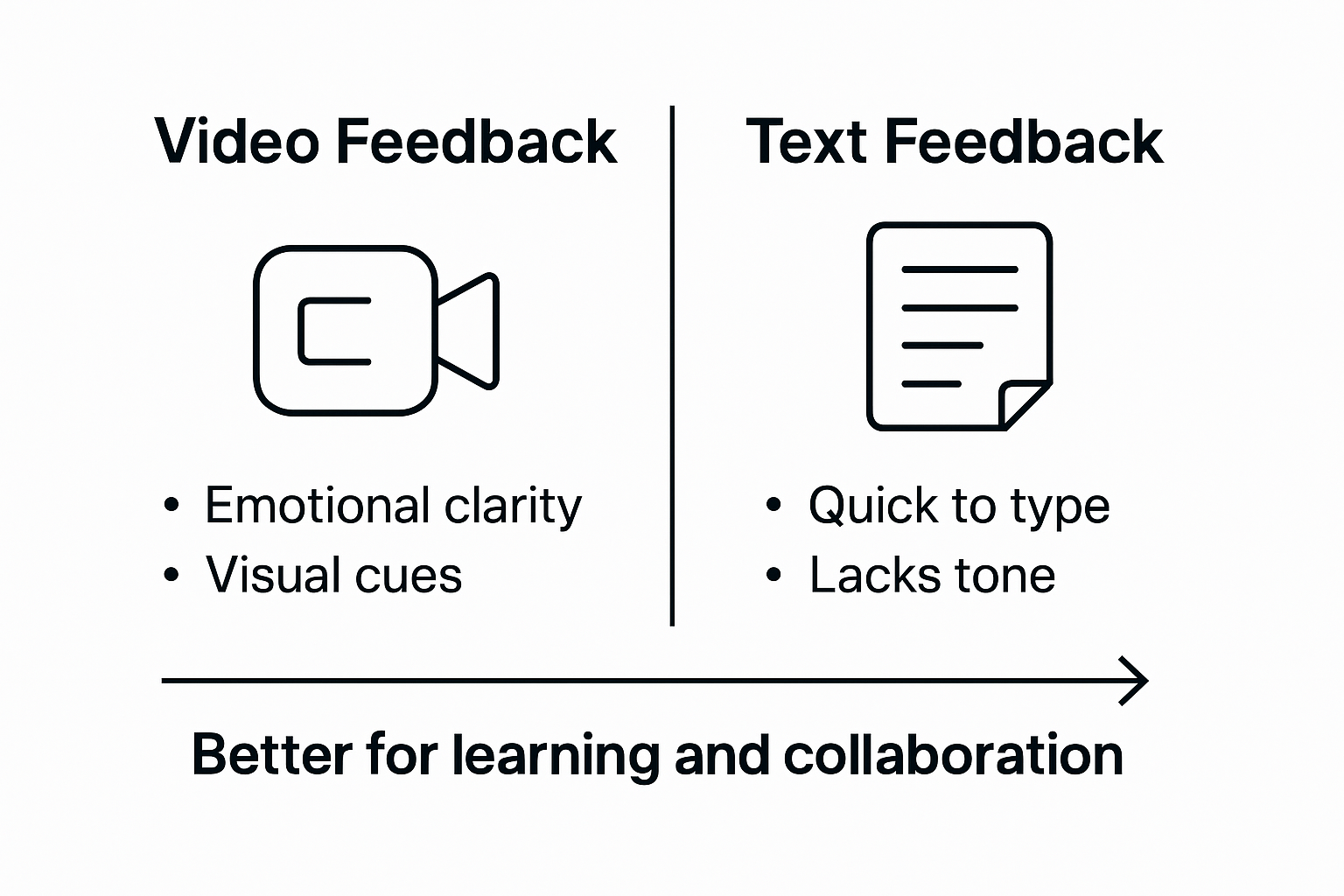
Creators and professionals gain significant advantages through video feedback's unique communication capabilities. Video presentation optimization techniques highlight the potential for more engaging, precise content delivery. Key benefits include enhanced clarity, reduced misunderstandings, and the ability to convey complex ideas through visual and verbal demonstrations that transcend traditional text-based communication.
Ultimately, video feedback represents more than a communication tool—it's a strategic approach to knowledge sharing that adapts to the evolving needs of modern teams, educators, and creators. By combining visual context, personal connection, and flexible delivery, this approach breaks down traditional communication barriers, enabling more meaningful, efficient, and impactful interactions across diverse professional landscapes.
Risks, Privacy Concerns, and Mitigation Strategies
Video feedback technology introduces complex privacy challenges that demand proactive and strategic management. Advanced AI collaboration tools underscore the critical importance of implementing robust security protocols to protect sensitive information shared through visual communication channels. Privacy risks emerge from multiple dimensions, including potential unauthorized access, data storage vulnerabilities, and unintended content distribution.
Organizations must develop comprehensive strategies to address these concerns. Instructional video guidelines recommend establishing clear consent mechanisms and transparent communication protocols. Implementing multi-layered security approaches involves several key strategies: encrypting video content, restricting access through robust authentication methods, and creating explicit usage policies that define boundaries for video feedback sharing and retention.
Technical mitigation requires a holistic approach to data protection. Video presentation security techniques highlight the importance of platform selection, user permissions, and advanced encryption technologies. Critical mitigation strategies include implementing end-to-end encryption, providing granular access controls, enabling temporary content access, and developing comprehensive user consent frameworks that empower individuals to manage their digital footprint.
Ultimately, successful video feedback implementation demands a balanced approach that prioritizes innovation while maintaining rigorous privacy standards. Organizations must continuously evolve their security strategies, staying ahead of technological advances and potential vulnerabilities. By fostering a culture of transparency, informed consent, and proactive privacy management, teams can harness the transformative potential of video feedback while protecting individual and collective interests.
Transform Your Video Feedback Into Seamless Collaboration with Boom
The article highlights how video feedback reshapes communication by adding clarity, emotional context, and flexibility beyond traditional text or live meetings. If you find yourself facing challenges like scheduling conflicts, unclear feedback, or the pressure of synchronous communication, you are not alone. Video feedback, especially async video feedback, opens doors to deeper understanding and effective collaboration — when paired with the right tools.
Boom is designed precisely for professionals, teams, and creators who want to earn time back while sharing powerful, clear video feedback. With features like voice-to-video recording, AI-powered scripting, multilingual dubbing, and instant branding, Boom takes the complexity out of async communication so you focus on what matters. Whether you need to share detailed screen recordings, personalized webcam feedback, or precise product explanations, Boom's async-first design fits perfectly with the article’s insights on improving communication without meetings.
Ready to ditch the meeting overload and embrace a smarter way to give and receive video feedback? Discover Boom and explore how our async video communication strategies can unlock clarity, connection, and productivity for your team today.
Start saving hours every week by turning your valuable feedback into crisp, engaging videos with Boom. Try it now for free and transform how you collaborate forever.
Frequently Asked Questions
What is video feedback and how does it differ from traditional text-based communication?
Video feedback is a process of providing visual and verbal commentary through recorded video messages, allowing for nuanced expression and better contextual understanding compared to traditional text-based communication.
What are the different types of video feedback?
The different types of video feedback include webcam video feedback, screen recording feedback, and hybrid methods that combine both. Each type has unique strengths suited for specific use cases, such as personal interaction or detailed visual guidance.
How does asynchronous video feedback work and what are its advantages?
Asynchronous video feedback allows professionals to record and share detailed commentary without real-time constraints. Its advantages include flexibility for viewers to review at their convenience, more comprehensive explanations, and reducing misinterpretation in communication.
What are the potential privacy risks associated with video feedback and how can they be mitigated?
Privacy risks of video feedback include unauthorized access and data storage vulnerabilities. Mitigation strategies involve implementing secure protocols like encryption, restricting access through authentication methods, and establishing clear consent mechanisms.
Recommended
About the Author
Devdeep
Senior Software Engineer.