
AI Scripting Explained: Complete Guide for Creators
AI scripting explained in depth: learn definitions, core types, workflow, practical uses, limitations, and best practices in this comprehensive guide.
Daniel M
Author
AI Scripting Explained: Complete Guide for Creators

AI scripting is quickly transforming the way people approach content creation. Reports show that over 60 percent of professionals now use AI tools to help write and refine scripts. This rapid growth is changing expectations and raising new questions for anyone working with digital content. By clearing up myths and highlighting how AI scripting truly works, you can better harness its strengths while avoiding common mistakes.
Table of Contents
Key Takeaways
| Point | Details |
|---|---|
| AI Scripting Augments Creativity | AI scripting enhances human creativity rather than replacing it, requiring human direction for effective content generation. |
| Common Misconceptions Exist | Understanding AI's limitations, such as its lack of true context comprehension and dependence on human oversight, is essential. |
| Various AI Technologies | Different AI scripting technologies, including rule-based, machine learning, and natural language processing, serve distinct content creation needs. |
| Implement Responsible Practices | To address risks, adopt practices like rigorous human review, and ensure diverse, unbiased training data for AI systems. |
Defining AI Scripting and Common Misconceptions
- Defining AI Scripting and Common Misconceptions
- Main Types of AI Scripting Technologies
- How AI Scripting Works in Modern Tools
- Key Benefits and Real-World Use Cases
- Risks, Limitations, and What to Avoid
AI scripting represents a revolutionary approach to content generation where artificial intelligence technologies create, modify, and optimize written or spoken scripts with unprecedented efficiency. Unlike traditional scripting methods, AI scripting leverages machine learning algorithms to understand context, generate coherent narratives, and adapt content dynamically.
Contrary to popular belief, AI scripting is not about replacing human creativity but augmenting it. According to DigitalAI, AI operates through complex algorithms and data patterns, which means it lacks true human-like understanding. This limitation is crucial to recognize - AI can generate impressive scripts, but it still requires human oversight and creative direction.
Several common misconceptions surround AI scripting that creators should understand:
- Myth 1: AI Will Replace Human Writers
Reality: As GreenHat explains, AI is designed to augment human labor, not eliminate it. The technology handles routine tasks, freeing creators to focus on more complex and nuanced storytelling.
- Myth 2: AI Understands Context Perfectly
Reality: AI processes information through pattern recognition, not genuine comprehension. It can misinterpret subtle emotional or cultural nuances that humans naturally grasp.
- Myth 3: AI Scripting Works Instantly
Reality: Effective AI scripting requires careful input, training, and iterative refinement. It's a collaborative process between human creativity and technological capabilit

For creators looking to integrate AI scripting into their workflow, understanding these nuances is key. Learn more about automating video creation to see how AI can enhance your creative process without replacing your unique voice and vision.
Main Types of AI Scripting Technologies
AI scripting technologies have evolved into sophisticated systems that leverage different computational approaches to generate and optimize scripts. Symbolic AI and Machine Learning represent two primary paradigms that power modern scripting technologies, each offering unique capabilities for content creation.
According to Wikipedia, symbolic artificial intelligence uses high-level, human-readable representations of problems, employing tools like logic programming, production rules, and semantic networks. These systems excel at creating structured, rule-based scripts where logical reasoning and predefined knowledge frameworks guide content generation.
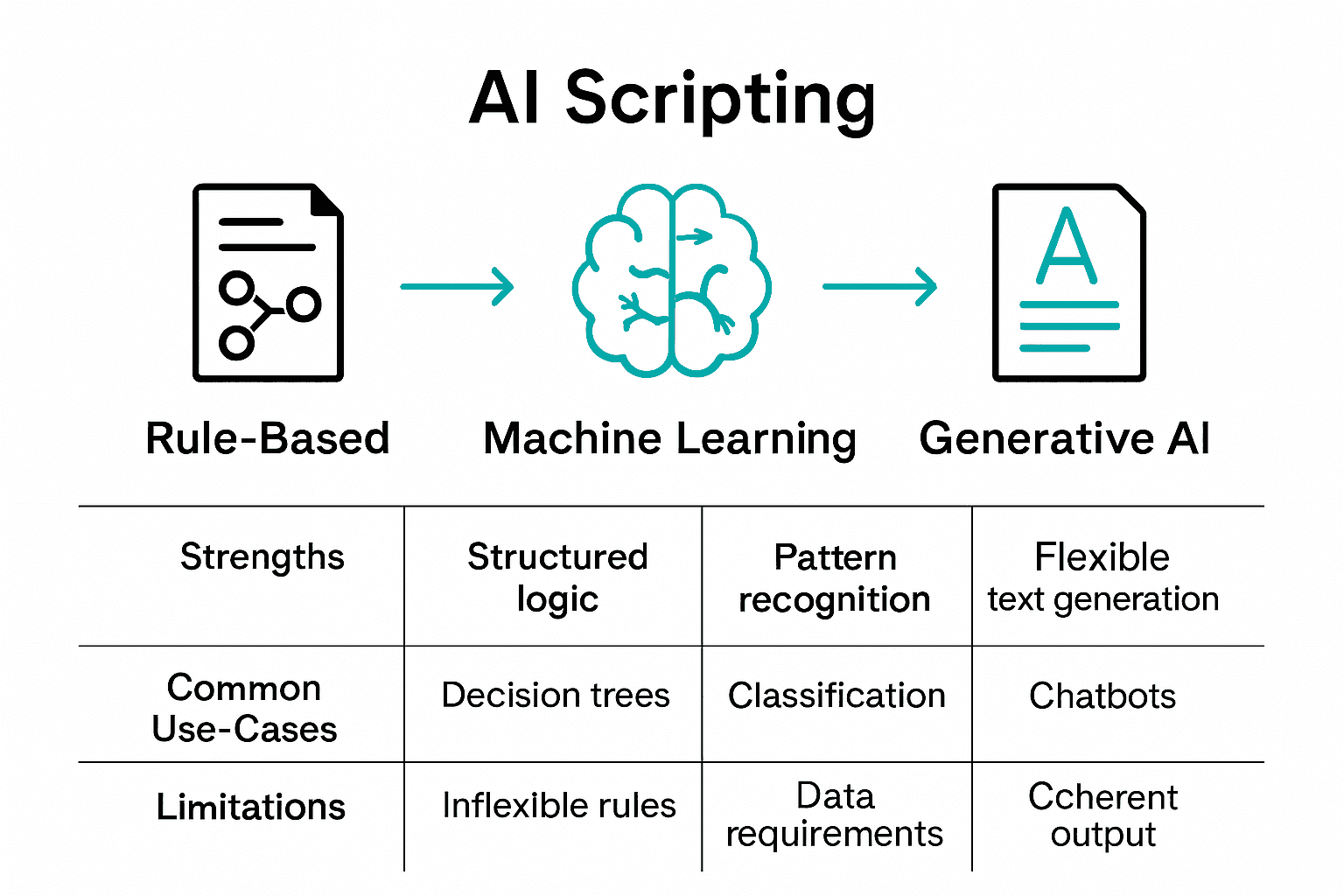
In contrast, contemporary AI scripting technologies can be broadly categorized into several key types:
- Rule-Based AI Scripting
Utilizes predefined logical rules and decision trees to generate content, ideal for scenarios with clear, structured parameters.
- Machine Learning AI Scripting
Leverages neural networks and deep learning algorithms to generate more dynamic and contextually adaptive scripts by learning from extensive data sets.
- Natural Language Processing (NLP) Scripting
Focuses on understanding and generating human-like text by analyzing linguistic patterns, semantic relationships, and contextual nuances.
- Generative AI Scripting
Employs advanced models like GPT to create original content by predicting and generating text based on complex probabilistic models.
As Wikipedia notes, scripting languages are fundamentally about automating processes, and AI scripting technologies extend this principle by dynamically generating and adapting scripts. Explore practical examples of AI productivity tools to understand how these technologies are transforming content creation workflows.
How AI Scripting Works in Modern Tools
AI scripting in modern tools represents a sophisticated intersection of machine learning, natural language processing, and computational linguistics. Large Language Models (LLMs) serve as the foundational technology driving these intelligent scripting systems, enabling unprecedented levels of automated content generation and adaptation.
Research from arXiv reveals a groundbreaking approach to AI scripting through offline simulation frameworks. These advanced systems leverage LLMs to curate software-specific script skillsets, employing intricate task creation and skill generation components that continuously refine and validate scripts based on execution feedback. This iterative process significantly improves automation success rates and reduces response times.
The core mechanics of AI scripting in modern tools typically involve several critical stages:
- Input Processing
Analyzing user intent, context, and specific requirements through advanced natural language understanding algorithms.
- Knowledge Mapping
Referencing extensive training datasets to generate contextually relevant and semantically coherent script content.
- Generation and Refinement
Dynamically creating script drafts and progressively improving them through machine learning feedback loops.
- Validation and Optimization
Comparing generated scripts against predefined quality metrics and user expectations to ensure accuracy and relevanc
e.
According to arXiv, deep learning methods have revolutionized code intelligence, creating sophisticated conversational assistants capable of understanding and generating complex scripts across various domains. Understand the role of AI in content creation to explore how these technologies are transforming creative workflows and expanding the boundaries of automated content generation.
Key Benefits and Real-World Use Cases
AI scripting technologies have transformed how creators, businesses, and professionals develop and execute complex content strategies across multiple domains. Intelligent script generation now enables unprecedented efficiency, creativity, and precision in workflow automation and content production.
According to Verulean, the democratization of AI development through no-code and low-code platforms is making advanced scripting capabilities accessible to a broader range of professionals. This technological shift means creators no longer need extensive coding knowledge to leverage sophisticated AI scripting tools.
Key benefits of AI scripting technologies span multiple professional domains:
- Productivity Enhancement
Automate repetitive scripting tasks, freeing creative professionals to focus on high-value strategic work.
- Consistency and Quality Control
Generate scripts with standardized formatting, tone, and structural integrity across different projects.
- Rapid Iteration and Adaptation
Quickly modify and refine scripts based on real-time feedback and evolving project requirements.
- Multilingual and Cross-Cultural Capabilities
Create scripts that can be instantly translated and culturally adapted for global audiences.
Real-world use cases demonstrate the transformative potential of AI scripting across industries:
- Sales and Marketing
Generating personalized pitch scripts, email templates, and targeted content sequences.
- Software Development
Automating documentation, generating code snippets, and creating technical specifications.
- Content Creation
Drafting video scripts, podcast outlines, and social media content with remarkable speed and precision.
- Education and Training
Developing interactive learning materials and adaptive instructional scripts.
Explore effective AI collaboration tools to understand how these technologies are revolutionizing team productivity and creative workflows.
Risks, Limitations, and What to Avoid
AI scripting technologies, while powerful, are not infallible magic solutions. Responsible implementation requires a nuanced understanding of their inherent limitations and potential risks that can significantly impact content quality and organizational workflows.
According to Synechron, AI functions strictly within predefined parameters set by its creators, lacking consciousness or independent decision-making capabilities. This fundamental limitation means that AI scripting tools require continuous human oversight and strategic guidance to prevent potential errors or unintended outcomes.
Key risks and limitations creators must carefully navigate include:
- Contextual Misunderstandings
AI may misinterpret subtle nuances, cultural references, or complex emotional contexts that humans naturally understand.
- Data Bias Inheritance
As Phenom highlights, AI systems can inadvertently perpetuate biases present in their training data, potentially generating problematic or skewed content.
- Creativity Limitations
While impressive, AI-generated scripts often lack true originality and may produce repetitive or generic content without human creative intervention.
- Ethical Considerations
Potential issues around content ownership, copyright, and intellectual property rights remain complex and evolving.
To mitigate these risks, creators should adopt a strategic approach:
- Implement Rigorous Human Review
Always have human experts validate and refine AI-generated scripts.
- Diversify Training Data
Ensure AI models are trained on comprehensive, unbiased, and representative datasets.
- Maintain Creative Control
Use AI as a collaborative tool, not a complete replacement for human creativity.
- Stay Updated on Ethical Guidelines
Continuously educate yourself on emerging AI content creation standards.
Explore practical examples of AI collaboration tools to understand how to effectively integrate AI technologies while maintaining high-quality creative standards.
Unlock the Power of AI Scripting with Boom
Struggling to balance creativity with the demands of crafting perfect scripts? The article highlights how AI scripting can boost productivity yet requires the right tools to truly shine. If you want to move beyond misconceptions and enjoy seamless AI-powered content creation, Boom is your solution. With features like auto-scripting that generate clear, goal-driven scripts instantly and AI voiceover & multilingual dubbing, Boom transforms your raw ideas into polished, brand-ready videos without any hassle.

Experience the future of content creation where every video you make is time earned. No scheduling headaches, no repetitive tweaks, just fast, clear communication that feels human and professional. Start turning your script visions into reality with Boom. Visit boomshare.ai and see how auto-scripting and AI-powered video creation can save you hours every week.
Frequently Asked Questions
What is AI scripting and how does it work?
AI scripting involves the use of artificial intelligence technologies to generate, modify, and optimize written or spoken scripts. It works by leveraging machine learning algorithms and natural language processing to understand context and create coherent narratives.
Can AI scripting replace human writers?
No, AI scripting is designed to augment human writing, not replace it. While AI can automate routine tasks, human oversight and creativity are essential for nuanced storytelling and context understanding.
What are the main types of AI scripting technologies?
The main types of AI scripting technologies include Rule-Based AI Scripting, Machine Learning AI Scripting, Natural Language Processing (NLP) Scripting, and Generative AI Scripting, each with unique capabilities for content creation.
What are the risks and limitations of using AI scripting?
AI scripting has limitations such as contextual misunderstandings, the potential for data bias, creativity limitations, and ethical considerations. It is essential to implement rigorous human review and maintain creative control when using AI-generated content.
Recommended
- Boom - Free Screen Recorder & Video Editor
- Boom - Free Screen Recorder & Video Editor
- Boom - Free Screen Recorder & Video Editor
- Boom - Free Screen Recorder & Video Editor
- AI Writing -
- AI in creative process and ideation in mobile games campaigns - playablemaker.com AI in creative process and ideation in mobile games campaigns
About the Author
Daniel M
Contributor.